
There are four Navratris in a year. Of these, the Gupt Navratri falls in the months of Magha and Ashadha. The word “Gupt” means something that is secret or hidden. Although it is considered a secret or private observance, Gupt Navratri is considered a powerful period for spiritual practice and devotion.
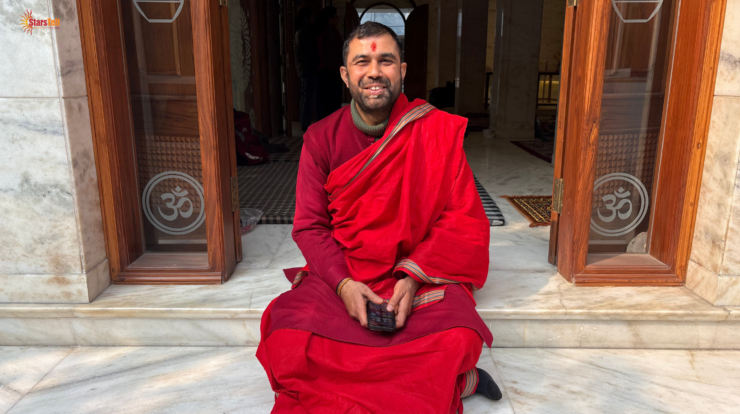
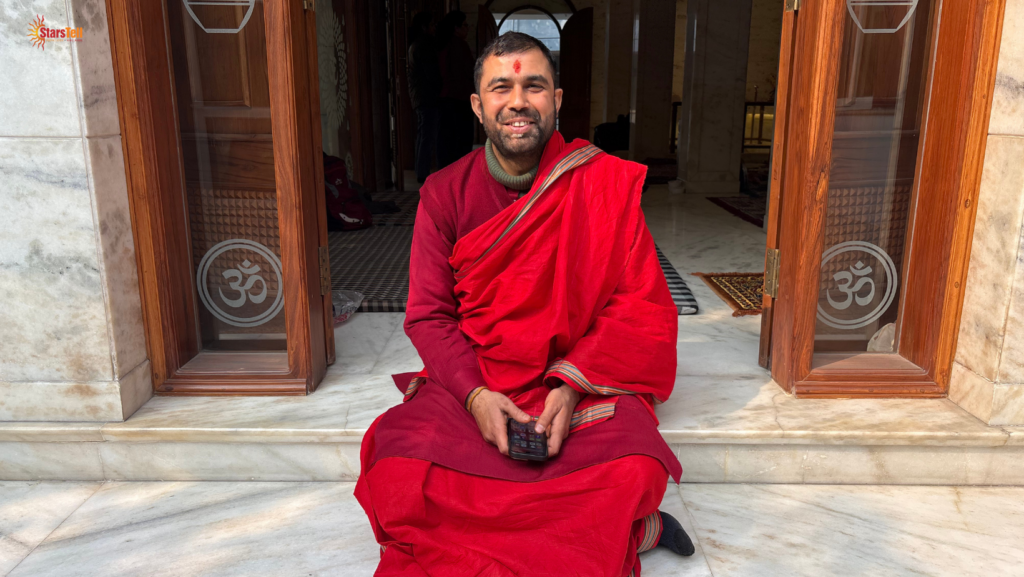
According to the Vedas and Puranas, performing the Shatachandi Path and Mahayagna during Gupt Navratri multiplies the power of one’s spiritual practice many times over and fulfills desires. Naturally, many questions arise in people’s minds regarding the Mahayagna. In this conversation, renowned Pandit Shri Keshav Upadhyay answers several questions, from the importance of the Shatachandi Path to its effects on life.
- Pandit Ji, first of all, we would like to know about you. How did your personal spiritual journey begin, and how did your connection with Goddess worship develop?
My spiritual journey began with the blessings of my ancestors and family tradition. When I first heard the hymns of Mother Durga in my childhood, that sound resonated deeply in my heart. Goddess worship is not just about chanting mantras, but about connecting with that primordial power of the universe which is the presiding deity of both creation and destruction. My connection deepened when I experienced that fear within a person vanishes when they take refuge in the Mother.
- When did the Shatchandi Path or Shatchandi Yagna first come into your life? What special experience did you have at that time that sets it apart from other spiritual practices?
The Shatchandi Mahayagna first came into my life as a guru’s instruction. While other spiritual practices provide personal peace, in the Shatchandi Yagna I experienced a tremendous energy. It was as if the radiance of millions of suns was manifesting simultaneously. Its unique feature is that it not only purifies the practitioner but also burns away the negativity of the entire region and the family of the host.
- What exactly is the Shatchandi Path? Is it related to the Durga Saptashati?
The Shatchandi Mahayagna is entirely based on the Shri Durga Saptashati. It involves the systematic recitation and performance of Havan (fire ritual) of the 700 verses described in the Markandeya Purana. When 100 repetitions (recitations) of these 700 verses are completed and a tenth of them are offered in the Havan, it is called ‘Shatchandi’. It is the greatest means of pleasing Mother Bhagwati.
- In your experience, has the Shatchandi Path proven effective in solving all of people’s problems?
Yes, in my experience, the Shatchandi Mahayagna has proven infallible. Whether it is incurable diseases, extreme poverty, enemy obstacles, or mental unrest—when all human efforts fail, this Mahayagna acts like divine intervention. It has the power to change even the most difficult destiny.
- Why is the Shatachandi Path called a Mahayagna (great sacrifice)? What is the role of discipline, number, and continuity in it?
It is called a ‘Mahayagna’ because it combines ‘knowledge’, ‘devotion’, and ‘action’. Discipline (purity), number (completeness of mantras), and continuity (uninterrupted adherence to rules) are its essence. Even a single error reduces the efficacy, therefore, its sanctity elevates it above other yagnas.
- Reciting the 700 verses of Durga Saptashati 108 times is called Shatachandi. What is the spiritual significance of the number 108 here?
The number 108 is cosmic. There are 108 main nadis (energy channels) in our body, and according to astronomy, the ratio of the distance between the Sun, Earth, and Moon is also around this number. In Shatachandi, 100 recitations are primary, and 8 recitations are kept as ‘additional’ or for purification, so that there is no deficiency in the completeness of the yagna. This number is the link that connects the soul to Shiva (the Supreme Being).
- Which individuals should definitely perform the Shatachandi Path?
Those who are facing continuous obstacles in life, whose business or career has stalled, whose family is experiencing discord, or those who want to attain spiritual progress and the special grace of the Divine Mother, should definitely perform this yagna. 8. Is it necessary to consult a horoscope before performing the Shatachandi Path, or do life circumstances themselves indicate the need for it? A horoscope shows the position of the planets, but circumstances show the actual results. Even if there are ‘planetary defects’ in the horoscope, and even if ‘unexplained crises’ are occurring in life, Shatachandi is the best solution. Often, circumstances themselves indicate that it is time to seek refuge in divine power.
- Should this yagna be performed only when problems arise, or also for future protection and balance?
It is not just a ‘cure for illness’, but also a ‘protector of health’. When problems arise, it alleviates the crisis, and if performed during times of happiness, it prevents future obstacles from arising and stabilizes the family’s progress.
- Why is Gupt Navratri considered the most suitable time for the Shatachandi Path?
Gupt Navratri is a night of ‘sadhana’ (spiritual practice). While regular Navratri is primarily a festival, Gupt Navratri is ideal for tantric and sattvic practices performed secretly for the acquisition of power. During this time, the gates of the universe are open, and prayers reach the Mother directly.
- What quick results can be expected from performing the Shatachandi Yagna during this Gupt Navratri from January 16th to 26th?
During this specific period, the planetary positions are such that they are extremely auspicious for the fulfillment of resolutions. A Shatachandi Yagna performed at this time is ‘quickly fruitful’ because the flow of sattva (purity) and power in the atmosphere is at its peak. This is the greatest opportunity to overcome the obstacles of the new year.
- Why is pure pronunciation and the role of a qualified priest considered so important in the Shatachandi Yagna?
Mantras are ‘sound energy’. If the pronunciation is incorrect, its effect can be reversed or nullified. A qualified priest is one who has himself performed the sadhana and has knowledge of rhythm and intonation. Just as only a skilled doctor can perform the correct surgery, only a knowledgeable Brahmin can direct the energy of the yagna in the right direction.
- Many people today are struggling alone and feel that they have tried everything—what does the Shatachandi Mahayagna mean for such people?
For those who are fighting alone, the Shatachandi Mahayagna is like the ‘Sudarshan Chakra’ (divine discus). It makes them realize that they are not alone, that the Mother’s power stands behind them. When a person gives up, that is where the Mother’s miracle begins.
- For the understanding of our listeners, could you briefly explain how the entire process of the 8-day Shatachandi recitation ritual is performed?
The 8-day ritual process: First day: Kalash Sthapana (installation of the sacred pot), Ganesh Puja (worship of Lord Ganesha), and Sankalpa (taking a vow). Second to sixth day: Daily worship, recitation of the prescribed chapters of Durga Saptashati. Seventh day: Completion of the recitations and Kumari Puja (worship of young girls). Eighth day: Mahayagna (grand fire ritual), Purnahuti (final offering), Visarjan (immersion ceremony), and Brahmin Bhojan (feeding of Brahmins). Agnihotra (fire ritual) and adorning the Goddess are key aspects performed daily.
- What message would you like to give to our listeners during this auspicious time of Gupt Navratri?
My message is, “Faith is the key to success.” Times may be difficult, but the power is infinite. During this Gupt Navratri, awaken the faith within yourselves and, if possible, participate in this grand ritual. May Goddess Bhagwati bless you all.
Know more about Shatchangi Mahayagna, talk to our Astrologist now!
For more, find us on Instagram
