
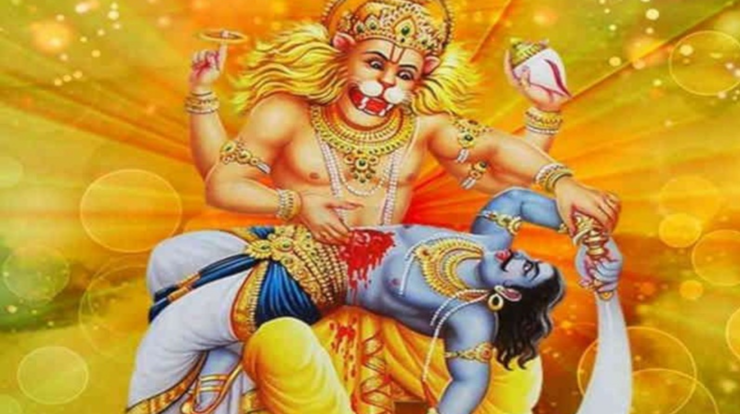
You have all likely heard the story of how Lord Narasimha slew the tyrant Hiranyakashipu to protect His devotee, Prahlada. Although His form appears fierce, His gentle heart serves as an abode for His devotees and their devotion. This divine episode illustrates that He remains ever-ready, at every moment, to protect His devotees. Consequently, His devotees worship Him on the Chaturthi (fourth day) of the Shukla Paksha (waxing phase of the moon) during the month of Vaishakha; this day is celebrated as Narasimha Jayanti. This festival symbolizes the triumph of good over evil. This year, Narsingh Jayanti will be celebrated on Thursday, April 30th 2020. First, let us understand the significance of Narsingh Jayanti.
The Significance of Narasimha Jayanti
On the auspicious occasion of this festival, devotees offer prayers and worship to Lord Narasimha and also observe a fast. On the day of Narasimha Jayanti, devotees wake up before sunrise, take a ritual bath, and then undertake the fast. Thereafter, they visit a temple—or perform worship at home—while chanting sacred mantras. It is customary to worship both Lord Narasimha and Goddess Lakshmi on this day. Doing so is believed to bring success into one’s life and enhance opportunities for happiness and prosperity.
Puja Shubh Muhurat
Event | Date | Time (IST) |
Chaturdashi Tithi Begins | April 29, 2026 | 7:51 PM |
Main Festival Day | April 30, 2026 | All Day |
Madhyahna Sankalp (Midday Vow) | April 30, 2026 | 11:19 AM – 1:53 PM |
Sayana Kala – Main Evening Puja | April 30, 2026 | 4:27 PM – 7:00 PM |
Chaturdashi Tithi Ends | April 30, 2026 | 9:12 PM |
Parana — Breaking the Fast | May 1, 2026 | After 6:11 AM |
Home Puja and Fasting Guide
- Wake Up During the Brahma Muhurta
On this day, to worship the Lord, wake up one and a half hours before sunrise—specifically during the Brahma Muhurta. At this time, the mind remains peaceful, and it aids in achieving mental concentration. This practice instills discipline in one’s life and helps maintain focus on one’s tasks.
- Purify and Calm the Inner and Outer Mind
Bathe before performing the *puja* (worship ritual); this brings a sense of coolness and tranquility to the mind. On this specific day, it is recommended to wear garments of red or yellow color. Both of these colors are associated with Lord Narasimha and hold special spiritual significance.
- Install the Deity’s Idol
To do this, clean the designated worship area and spread a clean cloth over it. Thereafter, install the idols of Goddess Lakshmi and Lord Narasimha. This practice fosters an enduring atmosphere of happiness, peace, and love within the home. Additionally, light a *ghee* lamp and offer yellow flowers to the Lord.
- Observe a Fast
After performing the *puja*, undertake a fast and immerse yourself completely in devotion to the Lord. Perform worship again during the evening hours. This practice helps in controlling the thoughts arising within the mind, while simultaneously bringing peace to both the inner and outer self. You may choose to observe a *Nirjala* fast (abstaining completely from water) or a *Phalahar* fast (subsisting on fruits). However, individuals suffering from any physical ailments or health issues should refrain from fasting.
- Evening Worship (Sandhya Puja)
This constitutes the most significant period for worship. During this time, sit facing either the East or the North direction to perform your prayers and rituals.
The first step is *Achaman*—the ritual purification. To perform this, sip a small amount of water three times while chanting the mantras: *Om Keshavaya Namah*, *Om Narayanaya Namah*, and *Om Madhavaya Namah*. This simple act brings peace to the mind.
Following this, perform the *Abhishekam* (ritual bathing). If you have a metal idol, perform the *Abhishekam* using milk, sugar, and water while chanting *Om Namo Narasimhaya*. If you are worshipping a picture or image, simply sprinkle a few drops of water upon it, and then gently wipe it clean.
Light incense sticks, *dhoop*, and ghee lamps to illuminate every corner of both your home and your mind. This helps dispel the growing gloominess in life and brings peace to the mind. Furthermore, the fragrance of the incense infuses life with renewed zest and enthusiasm, thereby driving away dullness.
On this day, Lord Narasimha manifested in His fierce form. Therefore, offer Him Bhog (sacred food offering) that provides a cooling effect. To this end, prepare a syrup made from jaggery; you may also add Tulsi (holy basil) leaves to it. Additionally, drain the water from soaked Moong Dal (green gram) and offer it as Bhog after mixing in some grated coconut. You may also offer sweets made from rice flour. Ensure that you include a Tulsi leaf in every offering.
Chant mantras and perform the Aarti. This brings peace to the mind and helps dispel any negativity that may be growing within.
Recite the Narasimha Kavacha. Through this recitation, the devotee surrenders themselves completely before the Lord and prays for His divine protection. Recite it two to three times, ensuring that you pronounce the verses correctly.
Finally, circumambulate the lamp three times while chanting mantras. After the *puja*, recite this specific mantra:
“Sri-nrisimha, jaya nrisimha, jaya jaya nrisimha
Prahladesha jaya padma-mukha-padma-bhringa”
Thereafter, distribute the *Prasad* among everyone present. Through this act, the Lord’s grace returns to His devotees in the form of blessings.
Want to know more, talk to our Astrologer now!
For more, find us on Instagram
