
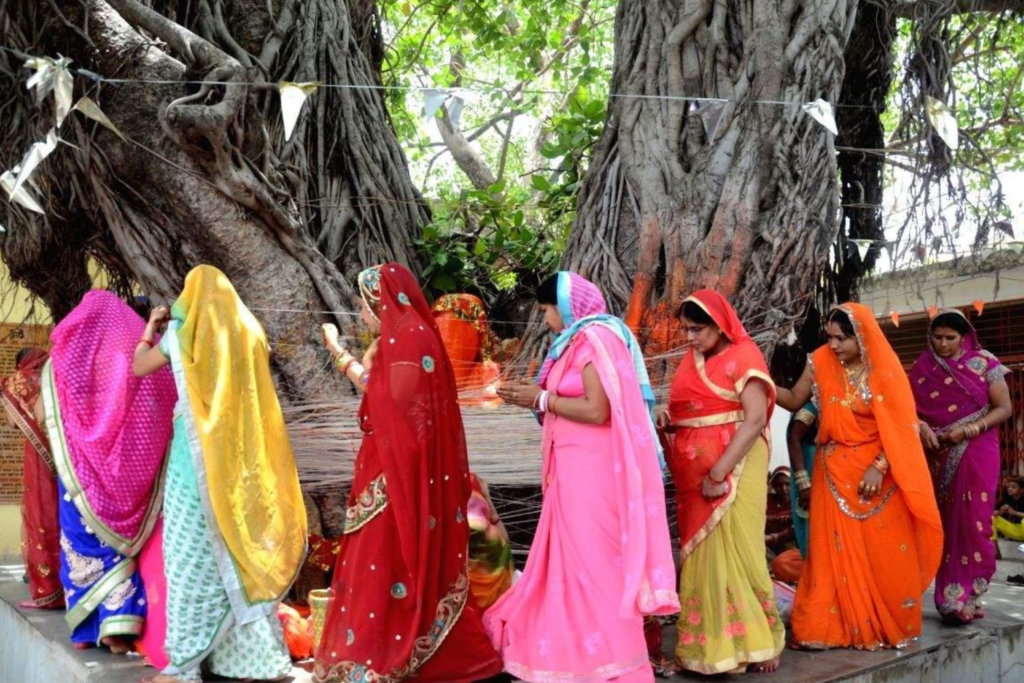
The Vat Savitri Vrat holds immense significance for married women within Indian culture. On this day, married women observe a fast to pray for the longevity of their husbands and perform worship rituals dedicated to the *Vat* tree—the Banyan tree. The Banyan is also revered as the “Divine Tree” (*Dev Vriksha*). In addition to being sacred, this tree is renowned for its longevity. Observing this fast is believed to bestow good fortune and create favourable conditions for conceiving children. This festival is celebrated on the Amavasya (New Moon) of the Hindu month of Jyeshtha. The inspiration for this fast is drawn from the legendary tale of Savitri and Satyavan.
Why is the Vat Savitri Vrat Observed?
According to mythological legends, King Ashwapati ruled the kingdom of Bhadra. He and his queen were childless. To be blessed with an heir, the King performed a grand Yajna (sacrificial ritual), offering one hundred thousand oblations. He continued these rituals systematically for eighteen years. Eventually, pleased with his devotion, Goddess Savitri appeared before the King and granted him a boon. Consequently, the King named his daughter Savitri. As his beautiful daughter grew up, the King struggled to find a suitable groom for her.
In search of a husband, Savitri wandered into the Tapovan (forest hermitage), where she met Satyavan. Subsequently, the King arranged for his daughter’s marriage to Satyavan. However, prior to the wedding, the sage Narada had already prophesied Satyavan’s short lifespan. He warned that while Satyavan was handsome and diligent, his death was inevitable within one year of his marriage. Yet, Savitri remained undeterred.
One day, while cutting wood in the forest, Satyavan suddenly collapsed and fell unconscious. When Yama—the God of Death—arrived to claim his soul, Savitri astonished even Yama with her extraordinary intellect and wit. Impressed by Savitri’s unwavering devotion and fidelity to her husband, Yama said to her, “O Goddess, ask of me any boon you desire.” She replied, “Grant me the boon of becoming the mother of sons.” Since Savitri was a *Pativrata* (a woman utterly devoted to her husband), Yama was compelled to release Satyavan’s soul. Thus, Satyavan was granted a new lease on life. It is for this very reason that the tradition of observing the Vat Savitri Vrat is followed.
Vat Savitri Vrat: Date and Auspicious Timings
According to the Vedic Panchang, the Vat Savitri Vrat is observed on the Amavasya (New Moonday) of the month of Jyeshtha. This Tithi (lunar day) begins on May 16 at 5:11 AM. Conversely, the Tithi concludes on May 17 at 1:30 AM. Consequently, the Vat Savitri Vrat will be observed on May 16.
How to Perform the Worship for Vat Savitri Vrat
To perform the worship and observe the fast on this day, wake up early in the morning, take a bath, and wear clean clothes. It is customary on this day to specifically wear garments in shades of red and yellow, and one must certainly adorn oneself with traditional makeup and jewelry. Thereafter, after seeking the blessings of the elders of the household, prepare the materials required for the worship. On this day, offer vermilion (sindoor), water, floral garlands, and unbroken rice (akshat) near the tree.
Additionally, tie a strand of raw cotton thread around the tree. The prescribed ritual involves tying this thread while circumambulating the tree—either seven, twenty-one, or one hundred and eight times. On this day, one must listen to the *Vrat Katha* (the story associated with the fast) and remain seated until its conclusion. Performing these rituals yields auspicious results and helps ward off any calamities or dangers that may befall one’s husband.
Adhering to these guidelines during the Vat Savitri Vrat ensures that one receives the full spiritual benefits of the worship.
On this day, one should refrain from breaking branches off the Banyan tree (Vat Vriksha), as it is believed to be the abode of Goddess Savitri.
On this day, married women should avoid wearing garments in blue or black colors; white attire should also be avoided.
Women observing this fast for the very first time should ensure that all items associated with marital auspiciousness (Suhag) are received from their maternal home.
The first Vat Savitri Vrat should be observed by a woman at her maternal home, rather than at her in-laws’ residence.
It is customary to listen to the sacred narrative (Katha) during the fast; rising and leaving midway through the narration is considered inappropriate.
On this day, raw cotton thread is tied around the tree. Therefore, while performing the ritual circumambulation, one should take care to avoid letting one’s feet touch those of another person.
To know more about Vat Savitri Vrat, talk to our astrologers now!
