
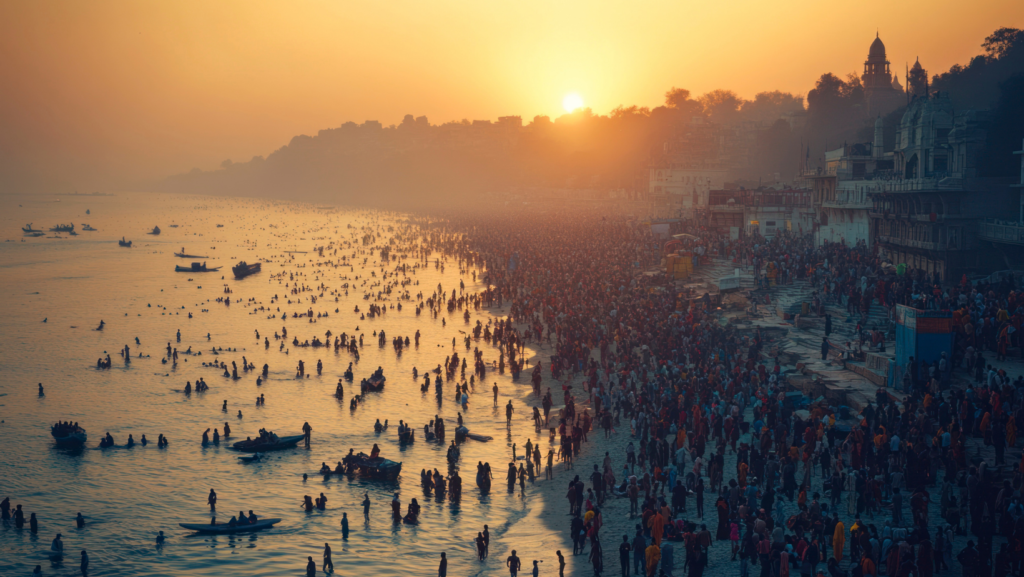
The Ganges is one of India’s vast and sacred rivers. Bathing in the Ganges is referred to as Mahasnan (the Great Bath). The festival of Ganga Saptami 2026 also known as Ganga Jayanti—is celebrated on the seventh day (*Saptami*) of the month of Vaishakh. This divine river is also revered as the bestower of *Moksha* (salvation). It is believed that on this very day, this holy river descended from the heavens to Earth. Consequently, this auspicious day symbolizes the re-manifestation—or rebirth—of Mother Ganga upon the Earth. Bathing in the Ganges holds special significance on this particular occasion.
Why is Bathing in the Ganges Important?
According to the Puranas, taking a dip in the holy river on this day grants liberation from sins and leads to the attainment of *Moksha*. For those who are unable to travel to the Ganges to bathe—or who face physical limitations of any kind—one may perform the ritual bath by mixing a small amount of Ganges water (*Ganga Jal*) into their regular bathwater. On Ganga Saptami 2026 occasion, people across India flock to sacred sites such as Haridwar, Varanasi, and Prayagraj to take holy dips and offer prayers with immense reverence and devotion. Let us now understand why the Ganges flows down to Earth specifically through the matted locks of Lord Shiva.
Why does the River Ganges descend to Earth via Lord Shiva’s head?
The question often arises: since the weight of the Ganges could conceivably have been borne by other parts of Shiva’s body, why did she emerge specifically from his head? According to the Puranas, when King Bhagiratha successfully completed the penance—originally undertaken by his ancestor, King Sagara—to bring the Ganges down to Earth, a critical question arose: how was she to be brought down? All the deities believed that her current was so torrential that the Earth would likely be unable to withstand it. At that juncture, Lord Shiva declared, “Mother Ganges, place your feet upon my head and make your descent to Earth.” Consequently, Mother Ganges descended precisely in that manner, flowing down over his head. It is widely believed that Mother Ganges is the elder sister of Goddess Parvati; therefore, to accord her due honour and respect, Lord Shiva deemed it appropriate to grant her a place upon his own head.
Another rationale is rooted in the belief that an individual attains liberation—or moksha—at the precise moment they pass through a “secret portal” to freedom. It is this very stream of divine nectar that flows down from atop Lord Shiva’s head to reach the Earth. Furthermore, Mother Ganges is revered as Mokshadayini—the Bestower of Liberation. Consequently, taking a holy dip in the Ganges holds immense spiritual significance; ultimately, at the end of their earthly journey, the individual merges back into her sacred waters.
Rules before taking holy dip on Ganga Saptami 2026
First and foremost, wake up early during the Brahma Muhurat, take a bath, and wear clean clothes. If you are unable to bathe in the Ganges due to physical limitations, mix some holy Ganges water (Gangajal) into your bathwater before bathing.
Next, prepare for the worship ceremony; offer prayers to Goddess Ganga using red and white flowers, incense, lamps (diyas), and sacred food offerings (*Prasad*). Seek her divine blessings.
Worshiping Lord Shiva and Mother Parvati after taking a holy dip in the Ganges yields exceptional spiritual rewards. Indeed, the River Ganges descended upon the Earth by flowing directly over Lord Shiva’s head.
Performing the Abhishek (ritual bathing) of Lord Shiva holds special significance on this occasion. For this auspicious ritual, Belpatra (Bael leaves) and Ganges water should be used to perform the *Abhishek* of Lord Shiva.
In addition to the worship rituals, recite the *Ganga Stotra*. Furthermore, chant sacred mantras such as “Om Namah Shivaya.”
On this day, helping the needy—particularly by feeding them—is considered highly auspicious. Additionally, you may donate clothes, water, and money according to the specific needs of others.
To accrue spiritual merit, performing Tarpan (ancestral rites) for one’s forefathers on this day is also considered extremely important. This practice helps you receive the blessings and special grace of your ancestors.
For the sake of peace and spiritual merit, light lamps (diyas) in the evening—either along the banks of a river, at a Ghat, or within your own home.
For more, find us on Instagram.
